It’s been a bit. The reasons for that are a bit dark, but I feel like I owe you stans of my blog an explanation: I have just flat-out been blog-uninspired. It’s apropos of nothing. And it’s a, “me problem” not a, “you problem”.
Anywho . . . technically this is part 3 of this series. I am calling this the “one year later” post, since I said I would write a “one year later post” in Part 2 of those posts.
Overall I will say that I have no regrets. So far, this has been the most fun I have ever had in my career. It’s not without its flaws, but I have been throughly enjoying myself.
Is Coming from the Customer Side an Advantage?
We can file this one under, “can confirm.” I am able to use my experience as a reference quite often and it, “adds credibility to the sale,” as I am told all the time. I should be clear though that I know quite a few SE’s who were never on the customer side and are some of the best SE’s I have ever worked with, so if you’ve never been on the customer side, don’t sell yourself short, you just have a different path.
Do I Want to Go Back to Doing What I Did Before?
No. Although, I will admit that a home lab will help me do my job better. When I set it up, I’ll blog about it, but as of right now I am spending my money on other things:
My 9-year old road-bike is so old I had to have wheels literally built for it. That set me back a bit.
I also invested in my golf game by getting a proper set of sized-for-me golf clubs after two decades of using Wal-Mart POS hand-me-downs.
This sentence is a retraction of an inappropriate joke about the skyrocketing price of cocaine, but I thought better of it.
How Do I Define Success as an SE?
Doing this for a year, I feel I can credibly talk about what defines success, and here’s my list:
- Do your homework. You do need to know your stuff, but also know your limitations. Be ready to claim that “you don’t know” something. IT people hate hacks and hate bullshitters even worse.
- Study up on the concept of opportunity cost. TL;DR – opportunity cost is the idea that you spend time or resources on one thing at the literal cost of others. I am not an economist, but I do crack open a book every once in a while. Understanding this concept rules my world. Don’t spend hours at a time on a $15K deal at the expense of a $1.5M deal. Prioritize and execute. I have come to find this part of the job invigorating, as you have to constantly re-prioritize.
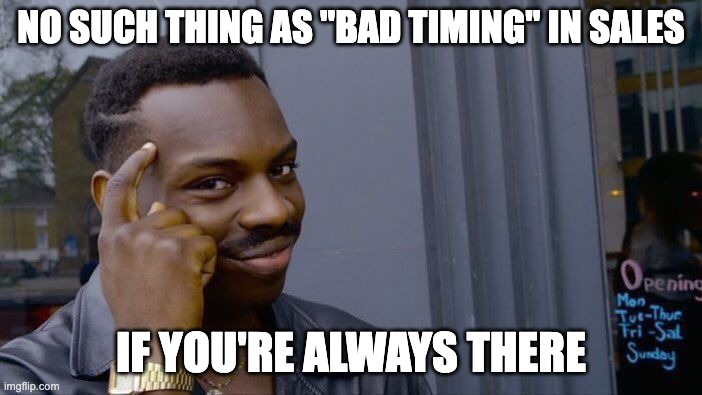
- Assuming your time is worth it, show up for your customer. Be there. Show up to the meetings, show up to the happy hours, show up to their events. Be there when things break, but equally important, be there when things aren’t broken. Be there when you’re not trying to sell them something. Provide a solution that provides value. They’ll call you when they want to buy. If you’re ever frustrated in Sales about “bad timing,” if you’re there all the time, then you’ll be there at the right time. Logic!
- Don’t be a dick. That’s it. That’s the tweet.
- The Numbers should be going in the right direction.
- Your AEs like you and feel like you are a part of their book of business. They involve you and trust you.
A Big Positive: My Self Improvement Has Been Kicked into Overdrive
Physical Health
Call it vanity if you want, but as referenced in this post, I didn’t want to be “the fat guy in the room”. I am still on a good workout plan: I workout 4 times a week at Orange Theory, although I did have a setback recently where my ankle inexplicably “became injured” (thanks to being 49), so I missed about a week and a half. But I am back now, full bore and it makes me happy. I am glad I have stuck with it.
Sartorial Upgrades
The new development since last year has been that I have stepped up my sartorial game. To give you an idea of where I started, during my first week at VMware, my idea of “dressing up” was putting on my best Tool t-shirt (yeah, that Tool) and wearing shorts that weren’t of the “cargo variety.”
For those of you cringing, cut me some slack will you? A t-shirt and shorts was the official uniform of the work-at-home Infrastructure Engineer, so “dressing nice” was not a part of my vocabulary. In fact, you are typically ridiculed in that world for wearing anything nicer than that, so, eat my (cargo) shorts.
I have stocked up on nicer pants (jeans of the designer variety and the like) and shorts, nicer shoes, polos and button-ups, and some nice logo pullovers. I even dress better outside of work, so there’s that.
For those interested, why is this important? Well, we talk to various levels of people in our accounts. Sometimes I am talking to some higher-ups, rather than to infrastructure engineers, and it’s the safe bet in front of Managers and C-level people to not look so slovenly.
And if you’re looking to improve one thing, get shirts that fit you properly. I know you might think that getting an oversized shirt will cover up all the fat, but the opposite is true.
Still Honing My Craft
And finally, now that I have been in-seat for a year and therefore into a routine, I am able to continue honing my craft. I am always trying to get better or know more about what I do. Right now, for example, I am reading VMware vSAN 8.0 U1 Express Storage Architecture Deep Dive. I spent an hour last weekend sifting through trainings on Azure Spring Apps.
I guess I am also becoming really good at stealthy but shameless plugs for our products . . .
What’s Stressful as an SE?
The job definitely has its perks. It’s true that there are a lot of Happy Hours and wining and dining. And my travel is pretty limited in frequency, time away from home, and distance. Most of the places I travel are like an hour plane ride away instead of across the country or, like, you know, in France.
The stressful part of my job is the sheer volume of activity. I am aligned with 4 total Account Execs. I am a shared resource, so it is not uncommon for me to be double/triple booked, even with a shared calendar. I have had gauntlet days of back-to-back meetings. If that’s not your thing, then you’re going to get stressed out super quick.
You have to learn how to manage that, measuring that against your sanity, the payoff involved and the aforementioned opportunity cost.
What’s Been Disappointing?
Leaving my old life as an Infrastructure Engineer, I spent a lot of time researching what to expect with the career change that I’ve made. I spent a lot of time talking to SE’s that I knew to anticipate what to expect and figure out if it was something I really wanted.
What I did not anticipate is the complacency of VMware Infra Engineers to succumb to their lot as “button clickers”. In fact, many of them are happy to keep doing that.
I made at least one post on this phenomenon, but I am sure I have mentioned it in other posts.
Anyway, the story I have for you is that I signed on for this job thinking, “Man, I am going to set the world ON FIRE with showing people how to do some really cool stuff! I am sure my customers are going to be totally interested in running everything from ‘ERMHERGHERDKURBERNERTERS!’ to Infrastructure as Code to some cool architectural challenges.”
Since then I have come to the harsh realization that those sentiments are few and far between. Even if there are infrastructure engineers who “get it,” there are a host of other blockers: their leadership doesn’t want to invest in “the cool stuff”, or it’s a straight up budgetary issue, or they are so busy putting out fires they don’t have the time. With that last one, I usually recommend this book.
I have come to terms with it, because I still get to talk about the cool stuff often enough.
And, as it turns out, I get as much satisfaction from providing a solution as I do from living vicariously through my customers.
Finger guns. Shiny tooth. Pinky ring.
 Thinking Out Cloud
Enjoy reading all your blog. Great to hear your opinion of the good and bad of role changes.
LikeLike